Technology
Security, written in the laws of physics.
From the no-cloning theorem to the 19″ rack: the full path of continuous-variable quantum key distribution.
Provable security
Three guarantees rooted in physics.
To intercept is to disturb
The no-cloning theorem makes it impossible to copy unknown quantum states. Any measurement by a third party adds noise that the receiver measures: privacy amplification removes what it could reveal, or the link aborts.
Independent of computing power
The secrecy of the key rests on physics and a security proof, not on the hardness of a mathematical problem or on the adversary’s computing power, now or in the future.
Resistant to harvest now, decrypt later
Traffic protected with QKD keys can be captured today but not decrypted tomorrow: the key is never exchanged in a form a future computer can break.
How it works
QKD in four steps.
Quantum key distribution lets two parties generate a secret key from the quantum properties of light. Any attempt at interception disturbs the states, and is detected.
State preparation
The transmitter encodes random values in the amplitude and phase of coherent states of light, with Gaussian modulation: the GG02 protocol.
Quantum channel
The states travel over standard single-mode fibre at 1550 nm. Because the channel is quantum, an eavesdropper cannot measure them without adding noise the receiver will see.
Coherent detection
The receiver measures both quadratures of the incoming states by heterodyne coherent detection against a locally generated local oscillator (LLO), removing the attacks that target a transmitted local oscillator.
Classical post‑processing
Over an authenticated classical channel, both parties estimate the channel parameters, correct errors with LDPC reconciliation and run privacy amplification. The result is a secret key under a composable, finite-size security proof, used to refresh AES-256 keys or as a one-time pad (OTP) for low-rate data.
Why CV-QKD
Coherent photonics, telecom engineering.
Continuous-variable QKD (CV-QKD) encodes information in the amplitude and phase quadratures of coherent laser light, a design choice with direct consequences for deployment.
Standard coherent components
Commercial lasers, IQ modulators and balanced coherent receivers. No single-photon detectors, no cryogenic cooling.
On the network you already have
Operation at 1550 nm in the telecom C-band, designed to share fibre with classical channels through dense wavelength-division multiplexing (DWDM).
High symbol rates, standard parts
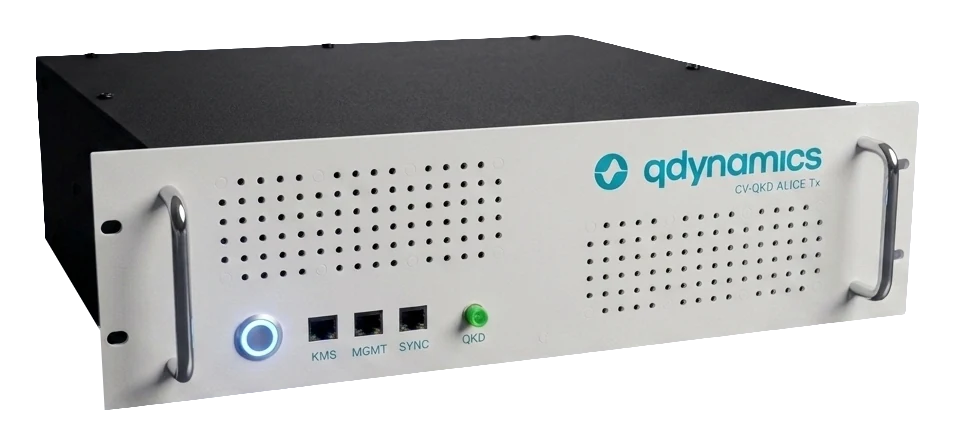
100 MBaud coherent transmission with standard telecom parts, in a 19″ rack format for data centres and telecom nodes.
For free-space and satellite links, Q-Dynamics uses discrete-variable QKD (DV-QKD): single photons, received and analysed by polarisation at the optical ground station (OGS).
From principle to product
The same physics, in a 19″ rack.
Two 3U units, ALICE Tx and BOB Rx, bring CV-QKD to your fibre; the OGS Quantum Stack brings DV-QKD reception to the ground segment.